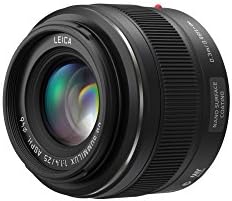
Panasonic H-X025E LEICA DG SUMMILUX 25 mm Digital Interchangeable Lens – – Good lens, but noisy
I found this lens to be great. Fast – wide open delivers very good performance and a bit closed things are going only better.
I have a lot of micro-four thirds (mft) lenses, but this is currently my favourite. I didn’t buy this when it first came out, because i already had the 20mm f1. Since upgrading to an e-m5, i wanted something with a faster auto-focus spead. I knew from all the reviews that the image quality of this lens would be fantastic, but i was nervous about the focus speed. I can confirm that it is good. The image quality and focusing speed is very similar to the olympus 45mm lens, which i also like. The 50mm equivalent focal length is very polyvolent, and the 1. 4 aperture combined with the stabilized e-m5 body makes low light photography very easy. A bonus when your camera doesn’t have a built in flash.
This is a decent lens, but it isn’t streets ahead of the panasonic 20mm that i also own. I’m a fussy photographer and have compared results from the two lenses carefully. The ‘leica’ is very slightly sharper in the corners, but not really enough to justify the extra cost. It has a lot more chromatic aberration (colour fringing) wide open than the 20mm. The only reason to buy this lens over the 20mm is for the extra half-stop of speed (f/1. 7), which isn’t a great difference, or if you really don’t like the slightly wider angle-of-view given by the 20mm. The manual focus action on this lens is beautifully smooth, and much nicer than the focusing ring on the non-leica panasonic lenses.
Nice bright lens with a fantastic focal point.
I am saying this as a professional wedding journalist, street and travel photographer. I have been a full frame pro canon users for the past 10 years and a pro leica shooter for two years. I have brought into the m4/3 system just over two years ago when i got the om-d. But since then, i was only shooting with the equally amazing m-zuiko 12mm 1:2. While that’s a quality and sharp wide angle lens, i always wanted something more normal. At time of purchase, there were only few choices for the m4/3. 95 or this the penny leica 25mm.
This lens is optically very good. However there are two points not usually mentioned in published reviews. Firstly, the camera (any m4/3 camera) in p mode would tend to set a wide aperture and a fast speed. 4 until the speed is well over 1/1000s. I suppose this is what most users want as we are reluctant to stop down such a fast lens. Still this should be kept in mind in use and if you actually want to stop down you need to monitor the aperture closely. Secondly, this lens can be noisy (a kind of buzzing sound). Especially in bright sunlight, it does an ‘aperture dance’ whereby the camera keeps altering the aperture very rapidly to obtain a sensible and somewhat stable viewfinder/lcd brightness. This is common to all wide aperture m4/3 lenses, but some of them have more noisy aperture and aperture motors than others and this one is very loud.
Well reviewed lens with a f1. 4 stop allows for good bokeh. The definition and image quality is great.
I bought this lens for my om-d as i have a 12mm & 45mm olympus lens to compliment it, olympus don’t make a 25mm and the 17mm gets so so reviews. Furthermore the 25mm sits rather well in between my kit and shooting recently in london i found there was a notable gap in my equipment. I only use primes on my om-d so i have been used to the stunning quality of images, the olympus 12mm & 45mm are amazing but nothing prepared me for how good this little beauty would be. It addes a beautiful tone/colour cast to all the images, maybe i am imagining it?.At the price it could be so??. But this is without doubt a quality piece of kit and saying that i have been using professional olympus glass on my e5 for a couple of years yet the 25mm has blown me away. The only drawback is its going to be stuck on your om-d and its not a zoom so you are going to wear out even more shoe leather walking backwards and forwards framing your imagesit does rattle a bit on the om-d but its not loud or intrusive and the olympus 45mm is also prone to the same problem, both only make the noise in bright sunlight, after a while you never notice itworth the money, not been off the camera since i got it.
In a nutshell: this lens is one of a rare breed of products that is better than expected – despite my expectations being very high. I already owned the well-regarded panasonic 20/1. 7 but it is lens i never grew to love, or even like, despite its hype. I can’t put my finger on why the 25/1. 4 is better (*much* better) for my tastes, the images have a completely different ‘look’ which has nothing to do with ‘sharpness’; both are more than adequate in that respect. Perhaps it’s the ‘pixie dust’ mentioned by another reviewer :-)not a lot to add, really. The lens is not as silent as claimed but much quieter (and faster) to focus than the 20/1. 7, but that doesn’t bother me anyway as i don’t do video. Bear this in mind if you do.
It is beautifully made and it does produce really sharp images but i have been disappointed: mostly my own fault though for not taking into consideration the focal length which translates into 50mm or so equivalent for a normal sized dslr. I will eventually px it for a 8 – 18mm or so lens – which should solve my problems. It always pays to do really thorough research and then repeat it to ensure that you are buying what you really need.
Having been a fan of the standard 50mm lens on 35mm film cameras this has brought my photography back full circle. I like the large aperture for available light photography.
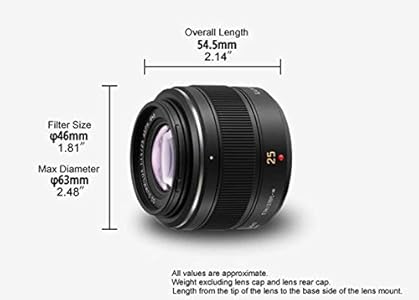
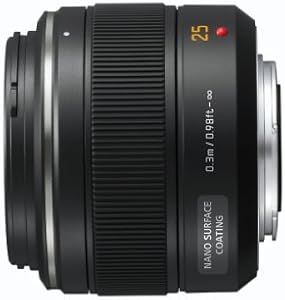
Note that i also have the panasonic 20mm and the nokton 25mm so i’ll mention some of their differences. It’s pretty exciting to get hold of the first f/1. 4 lens for the micro four thirds system. Thankfully, the leica brand didn’t add a whole lot more to the price tag, although i still think it’s a bit pricey. This lens is like the big brother of the 20mm. It’s twice the weight at 200g, and almost twice the height. The construction quality is good, mainly plastic, except for the metal mount. It has a 46mm filter thread – yeah, i can use my 2-stop nd filter from my 20mm lens. The focusing ring is nicely damp and turns smoothly. It comes with a carrying pouch and a relatively large plastic rectangular lens hood. Here are the specifications for the Panasonic H-X025E LEICA DG SUMMILUX 25 mm Digital Interchangeable Lens –:
- Make sure this fits
by entering your model number. - F1.4 brightness allowing an elegant soft focus
- Nano Surface Coating technology for dramatic reduction of ghost and flare
- A high-quality image quality that passes a stringent Leica standard
- UHR (Ultra-High Refractive) index lens and glass mould aspherical lenses
- Circular aperture diaphragm
Have been using this lens for over a year with both a g3 and gh3 as part of a growing lens collection from panasonic, olympus and samyang. Balance is just fine on both, well made, this is my go to lens for low light, no tripod available moments. Images are sharp right down to f1. 4 though they are really sharp at f2. There are not many lenses in the m4/3 range that can operate in low light as this can, great all round prime lens.
I’ve worked as a professional photographer for 25 years, and have been used to some pretty sharp lenses, and i can honestly say that this lens is as sharp as my hassleblad 80mm cf. However, i purchased mine in 2011 as part of the first ever batch, and because i knew the retailer, i was able to test all 10 or so he had in stock, and yes each one was different. I’m not a huge fan on micro 4/3, but have used them constantly just because of this lens, which has surpassed anything in the dslr range. So, i would strongly recommend trying this lens, taking it for a massive test drive, and return it if you’re one of the unlucky ones.My own complaint is that there isn’t a camera out there to do this lens justice; but only last week, i took pictures of a gig in low light with amazing results.
This is the nearest thing to having an autofocus leica lens on your panasonic g or olympus micro four thirds camera. At twice the weight and price of the legendary panasonic 20mm 1. 7 lens, this is a serious investment and feels like it, being obviously well put together when you hold it in your hand. At 50mm equivalent field of view (to 35mm systems) this is the so-called ‘standard’ lens, producing a field of view that is thought to feel very natural. I like it better than the 20mm, because with that lens the 40mm equivalent field of view can seem a bit odd – neither tele nor zoom, and not standard either. The 20mm also distorts faces if you shoot close-in portraits, which is often not flattering. 4, meaning the ability to get shallow depth of field, nice bokeh, and shoot in low light without cranking up the iso excessively. 4 the centre is pretty sharp, with the edges being soft.
I’m reviewing this as i have bought this to replace my standard 20mm pancake. I am absolutely thrilled with this lens. The main thing that i have noticed is how fast it is, the auto focus is rapid, even on moving objects. It will pick up and focus speedily which the standard 20mm seemed to struggle on heavily. Also the focusing motor is very silent compared to the 20mm pankcake which you would be able to hear on film but you won’t have that problem with this 25mm lens. I am only a light user so cannot go as indepth as other reviews on here, but can say that you cannot go wrong with this lens, albeit may be on the expensive side, you will own a high quality lens that won’t depreciate on value much so can sell on if your needs grow.
This is my principal interview lens for use with a gh5. Not quite as shallow a depth of field as my sony apsc kit but still blurs the background in a very pleasing manner with lovely colours and good sharpness. Works very well with indoors, available light video which i do a lot of. I’d give it five, but aperture switching is fairly noisy which was a wee bit disappointing on a lens of this price.
This lens is the sharpest and the fastest i have ever had and wouldn’t trade it for anything. You can capture motion in low light with no is. Colours are just perfect and no defects to my eyes at least. It is much cheaper than a leica and for the speed the price is doable. It’s relatively light for the number of lenses it has and is well build. I’ve had it for about 3 years and it essentially looks & feels new. Video is remarkable, although it’s not super quick at focusing. Once it focuses though it’s the best i’ve seen – full hd looks amazing and the bokeh is sublime. I would buy it again and when it comes to selling it perhaps 20 years down the line (if its possible to ever come up with something better) it will likely be worth more.
Reviews from purchasers :
-
Exceeds expectations
-
Great for video interviews
-
The ultimate lens for MFT
I bought this for my blackmagic pocket cinema camera and wanted a high quality lens with a native fit. The body seems very well made and solid with a nice weight to it. The glass of course is top notch and the lens is reported to give an excellent depth of field and bokeh compared to the inferior 20mm pancake lens. It’s quite big compared to other mft lens, about the size of my 50mm f/2. 8 canon lens, however the f/1. 4 is worth the money – bare in mind that canon’s equivalent f/1. 4 offering is significantly cheaper. With such an expensive lens, baring the leica brand, i would recommend getting a good filter to protect your well invested glass. This lens is pure quality and will most likely be my main goto lens while filming. It’s a must have for any mft owner.
If you want to have a good mft tool for everyday, this lens is a must. Very fast, it guarantees superb quality of images you take. The rest is fully depend on you as a photographer.
Great for low light, in fact great in any light.
A good trade-up from the f1. 8 20mm lens as this one is f1. 4, solidly built and great for portraits, but also video.
There’s something about the colours & contrast of this pana 25mm f1. 4 that makesreally lovely images. I’m talking about a clearly visible difference. A higher quality, a richness that i cant quite put my finger onsubjects seem really well defined, colours are rich, and i’m not talking about depth of field effectsbetter tham my other m4/3 primes. I’m comparing this to the olympus 45mm 1. 8all of which are good to excellent primes that i like and use.
I have yet to explore the full capability of this lens, but from initial experience and results, i endorse the many positive comments made by others. As an amateur, i can’t provide technical analysis, but i can say that the quality of photographs taken using my panasonic g5 in terms of sharpness and less definable but obvious results such as colour rendering are clearly in a different league from the two zooms i have previously used (and they were both carefully chosen for their relative quality). It is also excellent in low light situations given the wide maximum aperture which also has the advantage that you can manage depth of field to isolate subjects. Overall, i can say that this lens is likely to be on the camera a great deal in future and used in the way those of us of a certain age would have used a classic 35mm standard lens, which of course this emulates. Yes it is relatively expensive, but you really do get what you pay for, and you don’t have to be an expert to appreciate this.

Probably the best value lens for an mft camera. Excellent picture quality (even in jpeg), very well built. The only downside is that the hood cannot be turned around over the lens for storage. I bought it for a gx7 and i must say it suits it perfectly. In my view its a ‘must have lens’.
I bought this lens as a general walk-about lens for my omd em5 camera. I’m delighted with the results. My recent lake district holiday photos are sharp and contrasty in all apertures, a noticeable improvement over the bundled 12-50mm slow lens. They work best for individual portraits as even objects slightly out of plane can become out of focus. My very slight disappointment is the larger than anticipated size of the lens. It is chunky and sizeable for a csc lens negating the size advantage of the csc system.
Its a leica, what else do you want to know, nice compact and great quality.
There is something about certain lenses which impart a magical feel to images. This is the first lens i have owned on the mft mount that gives images a beautiful feel and vibrancy. While the panasonic 20mm f1. 7 is sharp and pretty much flawless, this lens adds some pixie dust to the images – they sparkle. In a straight comparison with my 20mm f1. 4 seems sharper still and with much punchier colours and smoother bokeh. The leica also focuses noticeably faster on my olympus om-d. While the leica is by no measure ‘cheap’, panasonic has, at least, included a flare guard and bag along with the front and rear caps.
I am one of those people who found it difficult to embrace micro four thirds (mft), having had several four thirds cameras and some standard and pro lenses. The panasonic leica summilux 25mm lens was for me the reason for trying mft. I use the lens on my olympus pen camera and certainly have not regretted buying it. For me it is not a lens i use everyday, since i do mainly landscape and architecture shots. But it certainly is the lens for indoor shooting when a flash would just destroy the atmosphere. And it is also great for low-light outside shots. Since it is so light sensitive, it is of course excellent for producing shallow depth of field images. I can certainly confirm that it has a wonderful, smooth bokeh. Some people have reported here and elsewhere that the lens makes clicking noises on an olympus camera.

The post Panasonic H-X025E LEICA DG SUMMILUX 25 mm Digital Interchangeable Lens – –
Good lens, but noisy


Comments
Post a Comment